The USPS is entering one of the most consequential modernization phases the mailing industry has seen in decades. Between the January 2026 operational updates and the trajectory signaled by the July rate case, mailers are facing structural changes that go well beyond postage prices. Together, these updates reshape how mail is prepared, documented, routed, and optimized—placing greater emphasis on shape-based processing, deeper SCF entry, and cleaner logistics.
January 2026: Operational Changes That Touch Every Workflow
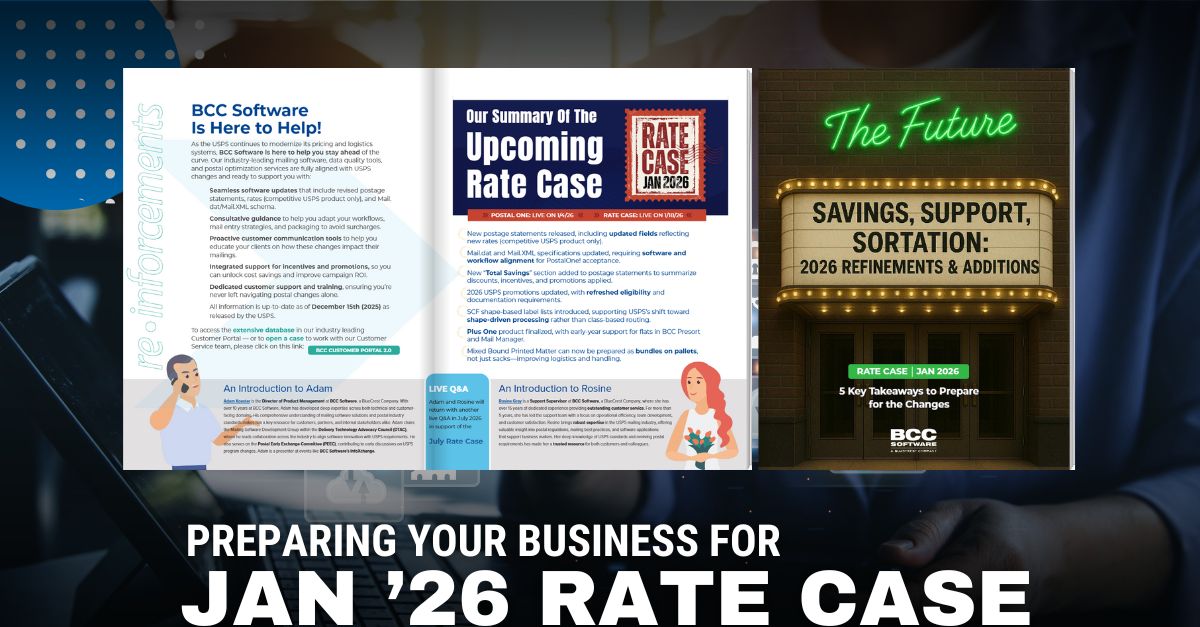
January introduces a comprehensive refresh of postage statements alongside updated Mail.dat and Mail.XML specifications. These changes reflect new rate structures, product definitions, and validation rules, directly impacting how jobs are prepared, transmitted, and accepted in PostalOne!. Mailers and software providers must align systems early to avoid processing disruptions.
A notable enhancement is the new “Total Savings” section on postage statements. This aggregates discounts, promotions, and incentives into a single view—giving marketing, finance, and client-facing teams clearer insight into postal ROI while simplifying auditing and reporting.
Promotion support is also updated for 2026. Programs such as Informed Delivery, Retargeting, Mobile Shopping, Tactile/Sensory, and Reply Mail IMbA now carry revised eligibility and documentation requirements. Accurate eDoc population and workflow validation are essential to prevent rejections or costly rework.
January 2026: Digital Magazine
Shape-Based Processing Takes Center Stage
USPS continues shifting from class-based routing to shape-driven processing, reflected in newly reorganized SCF Label Lists. Letters, flats, and parcels are increasingly aligned to processing equipment rather than traditional class distinctions. This change affects entry-point planning, palletization, container makeup, and drop-ship strategies—requiring updated presort logic and labeling rules.
New Product Capabilities and Preparation Flexibility
January also finalizes the Plus One product, allowing a single additional marketing piece to be included with a Marketing Mail letter at a low incremental cost. Early-year support for flats expands revenue opportunities for mailers and MSPs without major cost increases.
In another efficiency gain, Mixed Bound Printed Matter (BPM) may now be prepared as bundles on pallets—not just sacks. This improves stability, reduces manual handling, lowers transportation costs, and benefits high-volume shippers of books, catalogs, and educational materials.
Looking Ahead: July Rate Case Signals the Direction of Travel
The July rate case underscores USPS’s long-term strategy: simplify the network, reduce legacy complexity, and reward efficient preparation. Area Distribution Centers (ADCs) are removed, replaced by expanded SCF-based sortation. Network Distribution Centers (NDCs) are fully phased out for Marketing Mail parcels, cementing the SCF model as the foundation for routing and entry.
Periodicals undergo a major restructuring, with out-of-county pricing redesigned to more closely resemble Marketing Mail. Traditional bundle, container, and pallet surcharges are eliminated in favor of expanded SCF pallet and direct container discounts—encouraging cleaner logistics and deeper network entry.
USPS also introduces a new Marketing Mail “Heavy Printed Matter” product, filling a gap for dense, content-rich printed pieces that don’t fit neatly into flats or parcels. This improves rate accuracy, processing alignment, and categorization for complex printed formats.
What This Means for Mailers
These changes point to a cleaner, more predictable mailing environment—one driven by shape-based processing, streamlined product definitions, and incentives for efficient preparation. But success depends on readiness. Mailers must stay current with evolving specifications, update presort and eDoc workflows, and rely on adaptable software to remain compliant and capture available savings.
Preparing now isn’t just about avoiding disruption—it’s about positioning your operation to thrive as the USPS network continues to modernize in 2026 and beyond.